Västsvenska Handelskammaren x Chalmers Upskilling Academy
First one in our event-series: AI in production – Competence dialogues
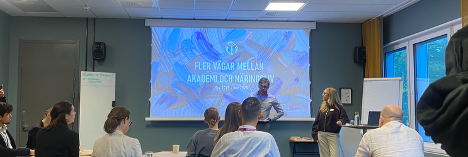
As part of the collaboration Fler vägar mellan akademi och näringsliv, running from November 2025 to November 2028, Västsvenska Handelskammaren (West Swedish Chamber of Commerce) and Chalmers Upskilling Academy organised a workshop. Representatives from companies and education gathered to discuss one key question shaping the future of work: What skills connected to “AI in production” will be needed as the workplace continues to change?
AI is not replacing people – it is augmenting them
One of the perspectives presented during the workshop was that the conversation should perhaps be about more than AI alone. Johan Stahre, Professor in Production Systems at Chalmers University of Technology, highlighted the concept of Intelligence Augmentation (IA). He referenced the idea of using technology that supports people while keeping humans in the loop.
This perspective is increasingly relevant as cognitive AI advances rapidly, and physical AI becomes more common in industry. Sweden already has close to 20,000 industrial robots, placing it among the world’s leading countries in industrial robotics.
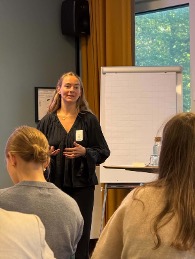
The rapid pace of technological development means that learning cannot stop when someone enters the workforce. Dr Greta Braun from Chalmers Upskilling Academy pointed to estimates that 39% of core skills are expected to change by 2030, highlighting the importance of continuous upskilling (World Economic Forum, 2025). Greta emphasized that this requires shared responsibility.
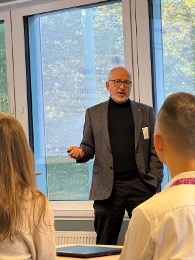
Individuals need to identify their skills and maintain an open mindset, while managers need to recognise skill gaps and create time and space for development, and education providers need to offer flexible ways of learning.
Skills for implementing AI in production
The discussions throughout the workshop showed that preparing for an AI-driven workplace is not only about adopting new technology. Companies also need the right foundations, from reliable data and secure handling of information to employees who have the confidence and knowledge to use new tools.
At the same time, continuous learning must also become part of everyday work. As technology advances and demographic changes reshape the workforce, companies will increasingly need to develop existing skills, create time for learning, and find practical ways to experiment with new solutions.
The workshop ultimately highlighted that the question is not simply how companies can implement AI, but how they can develop the people, knowledge and conditions needed to use it effectively. As AI continues to evolve, the ability to keep learning, adapting and working together may become just as important as technology itself.
Curious to join our next events with Västsvenska Handelskammaren?
Sign up here for our event about Robust supply chains on 28th October or here for Future Product and Production development on the 1st of December.
Related news

Who will pay for upskilling? The Almedalen perspective
The need for upskilling is increasing as demographics show a declining trend. Today, universities focus on educating young students, while...
Read more
Ny satsning på upskilling
I början av 2026 startar Chalmers Upskilling Academy, en ny satsning från Chalmers som kommer att erbjuda kompetensutveckling och vidareutbildning...
Read more
Ny satsning på upskilling
I början av 2026 startar Chalmers Uppskilling Academy, en ny satsning från Chalmers som kommer att erbjuda kompetensutveckling och vidareutbildning...
Read more